

Sorting Frenzy 1 - Quick Sort
Introduction
I’ve decided to improve my knowledge about sorting algorithms and this post is the first of this Sorting Frenzy!! After doing a research, I have compiled a small list of sorting algorithms that I will explain in this blog. The first winner is Quick Sort!
What is Quick Sort?
Quicksort is an efficient, general-purpose sorting algorithm. Quicksort was developed by British computer scientist Tony Hoare in 1959 and published in 1961. It is still a commonly used algorithm for sorting. Overall, it is slightly faster than merge sort and heapsort for randomized data, particularly on larger distributions. - Wikipedia
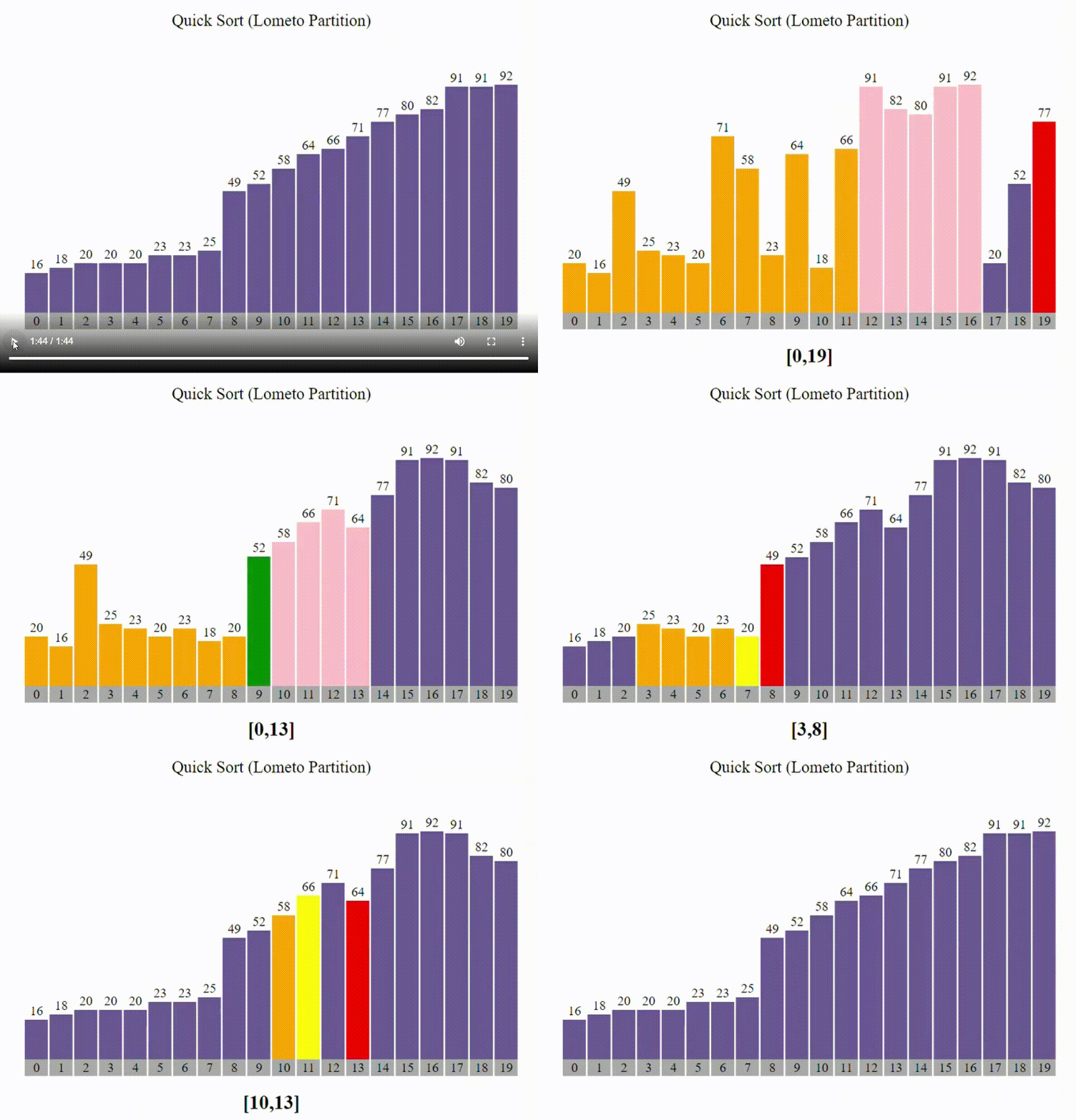
Quick Sort is a type of divide and conquer algorithm. It works by finding a pivot, reorganizing the array by putting smaller values than the pivot at the left and bigger at the right. Then it does the same thing recursively at each side until there is no elements left.
In this post, we’ll analyze a standard Quick Sort implementation and benchmark it with an array of 1,000,000 elements.
The code we will be analyzing:
private static int partition(int[] arr, int low, int high) {   int pivot = arr[high];   int i = low - 1;
   for (int j = low; j < high; j++) {       if (arr[j] <= pivot) {           swap(arr, ++i, j);       }   }
   swap(arr, i + 1, high);   return i + 1;}
private static void quickSort(int[] arr, int low, int high) {   if (low >= high)       return;
   int pivotIndex = partition(arr, low, high);
   quickSort(arr, low, pivotIndex - 1);   quickSort(arr, pivotIndex + 1, high);}
private static void swap(int[] arr, int i, int j) {   if (i != j) {       int temp = arr[i];       arr[i] = arr[j];       arr[j] = temp;   }}
Lets break it down
Method quickSort
This is the entry method for the sort and the one we will call recursively. First we have the base case: if (low >= high). This will be the exit point of the sort. This will trigger
when the sub-array we are sorting has only one element.
Second, we have to call the partition method to reorganize the array and return the “pivotIndex`. Then, we want to call the function again for the partitions at the left and at the right.
Method partition
This is the most important part of this sort. It has 2 objectives:
- Choosing a pivot
- We can choose any index but for the implementation its easier to choose the last element.
- Reorganizing the array around the pivot
- Values smaller or equal to the pivot go to the left
- Values greater go to the right
For the reorganizing part, we mantain a list of the smaller elements in the beginning of the array and after the loop, we put the pivot next to it.
Method swap
This method is just to mantain the logic of swapping values in an array outside of the partition method.
If you prefer a visual representation, below is a gif from geeksforgeeks.org:
Performance Analysis
Time Complexity: O(n log n)
In the average and best cases, Quick Sort is incredibly fast. For an array of 1,000,000 elements, the recursion tree is roughly 20 levels deep (2^20 ≈ 1,000,000). Each level of the tree requires O(n) operations to partition the elements, leading to a total complexity of O(n log n).
- Best Case: O(n log n)
- Average Case: O(n log n)
- Worst Case: O(n^2) (This occurs if the pivot is always the smallest or largest element, such as in an already sorted array).
Space Complexity: O(log n)
Quick Sort is in-place. It only requires a small amount of memory on the Call Stack for the recursive calls, making it highly memory-efficient.
Benchmarking the Results
Using a function to measure the duration, we tested this implementation with a randomized array of 1,000,000 integers.
public static void main(String[] args) {    int[] randomArray = ArrayUtils.generateRandomIntegerArray(1_000_000, 1, 1_000_000);
    measure(String.format("Quick Sort array with %d elements", randomArray.length),            () -> quickSort(randomArray, 0, randomArray.length - 1));
    if (ArrayUtils.checkSortedArray(randomArray)) {        System.out.println("Array is Sorted!");    } else {        System.out.println("Array is not Sorted!");    }
}
When running this, the results are impressive:
Quick Sort array with 1000000 elements took 77,540 msArray is Sorted!In 77,540 ms the algorithm processed a million integers! This speed is why Quick Sort (specifically variants like Dual-Pivot Quick Sort) is the default sorting algorithm for
primitive types in Java’s Arrays.sort().
Conclusion
Quick Sort remains a foundational algorithm for any developer. Its ability to sort vast amounts of data in-place with O(n log n) efficiency makes it a powerful tool. However, remember that for very small arrays, the overhead of recursion can be slower than a simple Insertion Sort. Modern libraries often use a “hybrid” approach, switching to Insertion Sort when the sub-array size drops below a certain threshold (usually 10-20 elements).
The code for this post can be found in my github.
Happy coding!
← Back to blog